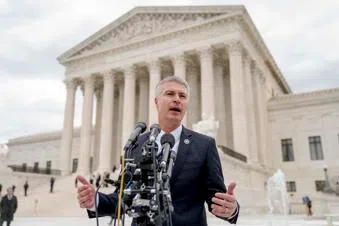
FILE - South Dakota Attorney General Marty Jackley speaks outside the U.S. Supreme Court, April 17, 2018, in Washington. (AP Photo/Andrew Harnik, File)
South Dakota Republican lawmakers who placed a state constitutional amendment on the Nov. 3 ballot have repeatedly said it would not automatically end expanded Medicaid eligibility.
It would merely give them authority, they’ve said, to consider ending the expansion if federal funding for it falls below 90%.
But the state’s Republican attorney general, Marty Jackley, said the amendment would automatically repeal Medicaid expansion if federal funding falls below that level. It’s his responsibility to write the ballot language, and the title he wrote says the amendment “repeals expanded Medicaid coverage” if federal funding drops below 90%, while the explanation he wrote says if that scenario occurs, the amendment “ends the expanded Medicaid coverage.”
The conflicting interpretations of Amendment I have set up a confusing situation for voters, who can begin advance voting today.
Medicaid is a federal-state health insurance program for people with low incomes. In 2022, South Dakota voters approved a citizen-initiated state constitutional amendment expanding Medicaid eligibility beyond coverage groups such as children, elderly people and disabled people to adults with incomes up to 138% of the poverty level. The expansion capitalized on a federal law passed during the President Barack Obama administration that covers 90% of states’ expansion costs.
Because the expansion is part of the state constitution, it can only be altered by voters.
Sponsoring lawmaker calls ballot language ‘inaccurate’
During the 2025 legislative session, the Republican-dominated South Dakota Legislature voted to send Amendment I to the ballot. Rep. Will Mortenson, R-Fort Pierre, who sponsored the legislation, said it “changes it from our hands being tied” if the federal government reduces its funding share for Medicaid expansion.

Lawmakers have estimated that if the federal government reduces its support to 70%, the state would be on the hook for about $72 million to sustain the expansion. That could mean cuts to other parts of the state budget to cover those costs, Mortenson said.
Mortenson described the ballot title and explanation as “100% inaccurate.”
“The title and the explanation both overstate what this does,” Mortenson said. “It would absolutely not immediately remove Medicaid coverage for the expansion population.”
The explanation should tell voters that the amendment would merely remove the requirement for expanded Medicaid coverage if federal funding falls below 90%, Mortenson said, while allowing lawmakers to then consider repealing, altering or maintaining Medicaid expansion.
Republican Lt. Gov. Tony Venhuizen was a legislator in early 2025 and was an original sponsor of the legislation that sent Amendment I to the ballot. He also disagrees with the ballot title and explanation.
“I would be a little concerned that it implies that this is automatic, and it is not,” Venhuizen said.
Attorney General Jackley published the final ballot language in May, after his office received no comments on an earlier published draft. He said the ballot language is accurate.
“When you look at what the legislative proposal was that the title is based upon and the language is, it’s very straightforward of how this would occur,” Jackley said. “And again, the Legislature made that decision.”
Mortenson said he hadn’t read the attorney general’s ballot title or explanation until recently, when Searchlight asked him about it.
“This is certainly not how I would have described this matter, and it seems to ignore the distinction between mandatory provisions of the constitution and permissive,” Mortenson said. “At this point I think it’s more about trying to educate voters about the practical impact, and I’ve got a fair amount of faith in the voters of the state of South Dakota.”
Pro-expansion voices respond
Deb Fischer-Clemens is a nurse, Democratic former state lawmaker and previously served as senior vice president of Avera’s Center for Public Policy. She’s currently president of the South Dakota Nurses Association.
She wants people to vote no on the ballot question. As of last month, the state Department of Social Services reported more than 31,000 South Dakotans were enrolled in expanded Medicaid, out of a total statewide Medicaid enrollment of about 143,000 people.
Fischer-Clemens worries people in the expansion group could be left without healthcare coverage if voters approve the constitutional amendment and federal funding for the expansion declines.
“Preventative care would go away for those folks, emergency room costs would go up for when they get sick,” she said. “They just wouldn’t have the same opportunities that people with insurance have. And it’s unfair.”
Fischer-Clemens interprets the amendment as immediately ending the Medicaid expansion if federal funding falls even a fraction of a percent, “and people would just be without,” she said.
If the amendment passes and Mortenson’s permissive interpretation of the language prevails, Fischer-Clemens said, the outcome is predictable. Many Republican lawmakers resisted Medicaid expansion, and it was only approved when citizens initiated a successful ballot question.
“These guys were not supportive of Medicaid expansion,” Fischer-Clemens said.
The expansion provides healthcare coverage for individuals who make less than about $22,000 a year, or families of four with an annual household income less than about $40,000, said Tim Rave, a Republican former legislator who’s now president and CEO of the South Dakota Association of Healthcare Organizations.
“It’s also important to remember that those people are getting taken care of regardless of their ability to pay at South Dakota hospitals,” Rave said. “But that also means the hospitals likely aren’t getting any reimbursement previous to Medicaid expansion for those services that are provided.”
Rave said about $400 million from the Medicaid expansion is paid annually to hospitals, clinics and other providers, which otherwise would have been unreimbursed care.
Rave said the amendment reads as automatic rather than permissive to him.
“I read the plain English of the bill. It says it will end if the federal match changes, period,” Rave said. “Anyone’s yet to convince me that, automatically, it stays in state statute.”
This year’s ballot question follows a constitutional amendment approved by voters in 2024, which gave the Legislature authority to establish work requirements for expanded Medicaid participation, pending federal approval. Federal work requirements approved last year could cause 1,213 South Dakotans to be disenrolled from expanded Medicaid after they take effect next year, according to an estimate by the state Department of Social Services.



Comments